Opportunities to develop custom code and UI to make scientific computing part of every workflow to accelerate scientific discovery, technology innovation and commercialization, and unparalleled process, energy, and material efficiency
Dr. Sreekanth Pannala
Computing power has grown exponentially, democratizing access to computational resources
From specialized monoliths to democratized, purpose-driven tools
Constructing models faster than real-time, trained against actual data and detailed computational data
Result: Real-time digital twins that democratize complex reactor modeling across the organization
Commercial reactors contain billions of particles. Tracking them all (Euler-Lagrange) is computationally impossible. Averaging them (Euler-Euler) loses the physics.
Phenomena spanning 10+ orders of magnitude in time and space
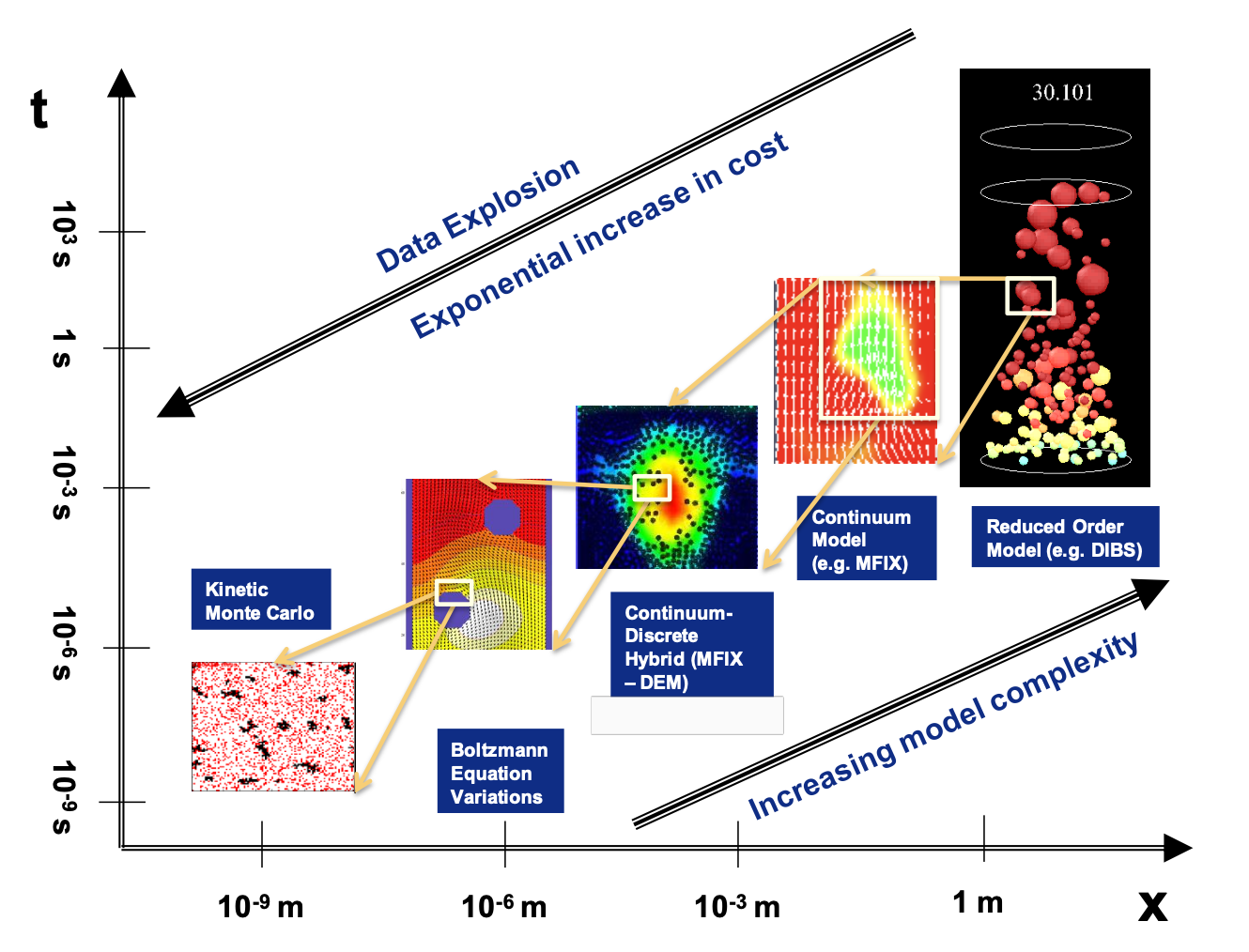
Direct Numerical Simulation tracks every particle and resolves all scales.
Two-Fluid Model averages out all structure using empirical closures.
Agent-based approach tracks mesoscale structures (bubbles, clusters) directly.
Instead of tracking particles, we track Bubbles as discrete agents.
Bubble A accelerates into B's wake
Adjust parameters
Time: 0.00 s
Bubbles: 0
Bed Height: 50.0%
Solids Conservation: Bubbles rise through solids. When bubbles reach freeboard (no solids), they merge into gas phase. Total solids volume is conserved.
Gas flows AROUND dense clusters.
Net Drag = LOW
Model sees uniform "soup".
Net Drag = HIGH (Incorrect)
We use DBSCAN (Density-Based Spatial Clustering) to identify clusters on the fly during the simulation.
Using NETL riser footage and image analysis to extract cluster statistics
High-speed camera records NETL pilot-scale riser (1m height, 800×588px, 15 fps)
Adaptive thresholding + morphological operations reveal cluster boundaries
Measure cluster properties to calibrate DHRDM parameters
NETL pilot-scale riser showing particle clusters
Adaptive threshold isolates dense regions
DBSCAN identifies clusters → calibrates φcrit, ε, minPts
Result: Experimental cluster statistics set realistic targets for simulation parameters
Simple models trained on rich datasets and made widely accessible can revolutionize scientific and process workflows
Democratizing modeling and simulation and scientific computing in the era of Generative AI creates unprecedented opportunities to develop custom code and UI, making scientific computing part of every workflow to accelerate scientific discovery, technology innovation and commercialization, and achieve unparalleled process, energy, and material efficiency
From years to months, from months to days
Everyone becomes a computational scientist
Process, energy, materials optimized in real-time
Dr. Sreekanth Pannala
Thank you
Chaos and Time Series Analysis Toolkit
A Python-based nonlinear dynamics and chaos theory analysis package inspired by TISEAN. TSDaw provides modern, modular implementations with both programmatic APIs and interactive web interfaces for analyzing chaotic and complex time series data.
Dedicated to C. Stuart Daw, educator and mentor in chaos theory
MIT License • Python 96.7%
Comprehensive chaos theory algorithms
Streamlit UI & FastAPI endpoints
Docker support for deployment
Author: Sreekanth Pannala (with assistance from Generative AI tools)
Dedicated to former colleague, mentor, and friend, C. Stuart Daw
17 Python files implementing chaos theory algorithms
FastAPI endpoints with Pydantic schemas
Streamlit & HTMX interfaces
Test Coverage
pytest + pytest-cov
Deployment
Docker Ready
Determine optimal embedding parameters before attractor reconstruction
Validate presence of nonlinear dynamics vs. stochastic noise
Measure sensitivity to initial conditions and fractal dimensions
Identify transitions and drift in system behavior patterns